
Personal self-defence at standing or striking range is the most common and recognisable domain of real-world self-protection. It addresses the situations civilians are most likely to encounter: verbal confrontations that escalate, aggressive posturing, pushes, grabs, punches, and close-range assaults that occur before anyone ends up on the ground.
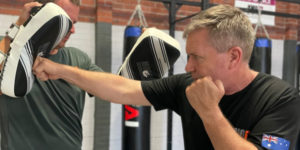 These incidents often happen suddenly and under emotional pressure. There may be little warning, limited space, and no clear “start” to the conflict. For this reason, Krav Maga treats standing self-defence as a decision-making problem first, and a physical one second.
A key focus in this domain is early recognition and prevention. Situational awareness, understanding body language, and setting clear boundaries can often stop a situation from becoming physical. Many confrontations can be avoided entirely if warning signs are recognised early and appropriate action is taken.
When physical engagement becomes unavoidable, the objective is not to win a fight, dominate an opponent, or exchange techniques. The goal is to protect oneself, disrupt the immediate threat, and create an opportunity to disengage. Techniques are deliberately simple, based on natural reactions and gross motor skills that function under adrenaline and stress.
Distance management is central to survivability at striking range. Being too close exposes a person to repeated strikes, while poor positioning limits escape options. Effective self-defence involves controlling space, angles, and timing to reduce the attacker’s effectiveness and increase one’s own safety.
Civilian context is also critical. Responses must be proportionate, legally defensible, and appropriate to the situation. Krav Maga emphasises responsibility alongside capability, reinforcing that self-defence is about safety, not aggression.
Personal self-defence at standing range forms the foundation of the entire system. The awareness, movement, and decision-making skills developed here carry directly into ground survival, weapons defence, multiple attackers, and third-party protection. It is the starting point for learning how to manage real-world violence with clarity, control, and purpose.